by Berend Booms, Associate Editor, Future of Assets
This International Women’s Day, I’d like you to consider what a little experiment I ran using generative AI illustrates about the state of gender equity in the world of asset management.
I asked ChatGPT to create an image of a maintenance engineer and, unsurprisingly, it generated a white male engineer. I then asked to create an image of two maintenance engineers, and the result was the same. My request for an image of three maintenance engineers yielded similar results; only after I asked to generate an image of four maintenance engineers did the first woman appear in the frame.
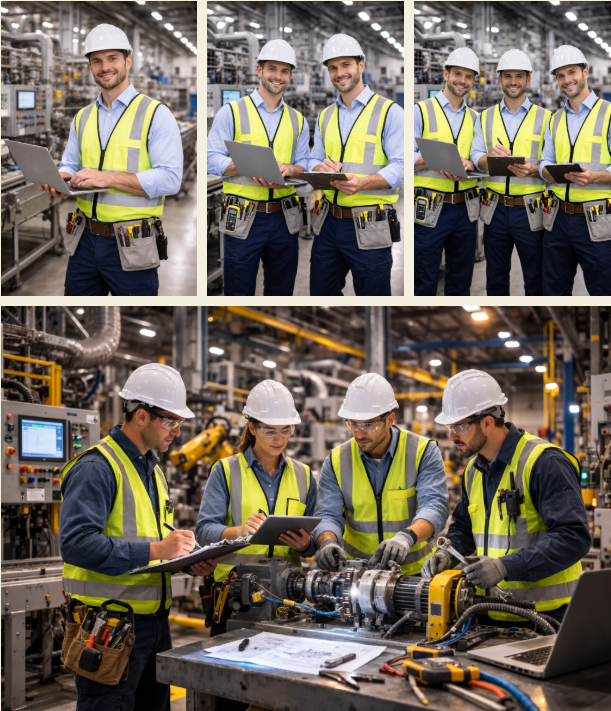
I was prompted to conduct this experiment after reading this article by Candi Robison, VP of EAM Strategy & Innovation at IFS Ultimo. While my approach is not scientific, the results are definitely revealing. Artificial intelligence does not invent assumptions; it reflects and scales what it has learned from existing data. If the dominant image of competence in maintenance has historically been male, then AI will simply reproduce this pattern.
I spoke with Candi last week about International Women’s Day, and she framed it as both a checkpoint and a commitment. After more than 25 years in enterprise asset management, she sees the day not as a symbolic celebration, but as a moment to assess what has truly changed and what patterns remain stubbornly intact. At the same time, she is clear in saying, “Awareness alone does not shift systems: progress requires sustained, structural action.”
The Critical Challenge of an Aging Workforce
Candi’s perspective is grounded in the realities our industry is facing. The skills shortage in maintenance is no longer a distant concern. According to Candi, “63 percent of organizations identify an aging workforce as the most critical challenge impacting their business, and half reported major disruption from recruitment challenges. Yet women represent only 7.6 percent of manufacturing maintenance technicians.” In a labor market under pressure, leaving such a significant portion of potential talent untapped is not only inequitable; it is strategically unsound.
The remedy might be found by turning to the rapid technological advancements taking hold of our industry. In her recent article on the future of maintenance, Candi writes that organizations are increasingly deploying agentic AI systems that function as digital colleagues. These systems learn from daily interactions and operating contexts, capture decisions and outcomes, and build a form of institutional memory that does not retire or change shifts. When designed well, they can preserve tacit knowledge, the subtle signals and troubleshooting instincts that do not always surface in dashboards or reports.
The opportunity is significant. This newfound knowledge equity could accelerate junior technicians toward expert-level performance. As administrative burdens decrease, expertise becomes more scalable and accessible. However, Candi raises a critical question that caught my attention: whose expertise are we capturing?
AI systems are not neutral. They learn from the people and processes that surround them. If the workforce training these systems remains overwhelmingly male, then the patterns, assumptions, and definitions of expertise embedded in the technology will reflect that same perspective. We have already seen in other domains how biased training data can lead to biased outcomes. Maintenance and asset management have the opportunity to approach this differently, but only if we act intentionally.
4 Solutions for a More Equitable Future of Assets
Candi outlines four solutions that are both tangible and measurable:
- First, recruiting and retaining women in maintenance roles must be treated as a business imperative, not a peripheral diversity initiative. This means modernizing how roles are branded, broadening sourcing channels, ensuring equitable shift structures and career progression pathways, and building team environments where respect and belonging are non-negotiable.
- Second, pathways into the profession need to be strengthened. Partnerships with schools, STEM programs, community colleges, and apprenticeship networks can make maintenance careers visible much earlier, particularly to young women who may never have been encouraged to consider this field.
- Third, as AI systems are implemented, knowledge capture must be designed with inclusion in mind. Organizations should ask deliberate questions: who is being interviewed as a subject matter expert, whose work orders are considered gold standard examples, who validates the system’s recommendations? The breadth of the system’s intelligence will only be as strong as the diversity of the expertise it learns from.
- Finally, and perhaps most importantly, the women already working in maintenance and reliability must be elevated visibly as experts, mentors, and leaders. Their knowledge will shape not only the next generation of technicians, but also the digital systems that support them.
Returning to my original AI prompt, the goal is not to validate the increment of engineers before a woman appears in the image. The goal is to build an industry where her presence is unremarkable because it is expected.
International Women’s Day should not be limited to recognition; it should be a catalyst for redesign. As Candi articulated so clearly, “We must make room, not just offer applause.” If we broaden participation today, we build smarter systems tomorrow. And in doing so, we strengthen not only representation, but the future performance and resilience of maintenance itself.