by Captain Darrin Vex, Chief Maintenance Officer, Imperial Engineering Corps
From the Imperial Maintenance Log of the Death Star (DS-1) Orbital Battle Station
Captain’s Log: 7972.4 | Scarif Debris Orbit
There is a peculiar irony in standing at the edge of a debris field that marks the end of one phase of this project, while being responsible for sustaining the next. Fragments of data archives and shattered assets from Scarif drift silently beyond the viewport, all remnants of the operation that secured the final technical schematics embedded within the systems I oversee.
The Death Star 1 Orbital Battle Station (DS-1) spans approximately 160 kilometers in diameter. This is a figure that will awe most civilians, but they fail to understand that from a maintenance perspective scale cannot be measured in kilometers. They are unable to comprehend that the true size of this operation resides in its systems, in all the access points, in inspections that take days rather than hours, and the harsh reality that with over a million personnel manning this station, there is no single individual with a complete view of the asset – or there wasn’t, until I took on the role of Chief Maintenance Officer.
Since taking this role, I have only met Grand Moff Tarkin once. It was during a briefing that was surprisingly lacking in operational detail, instead focused more on his confidence in the station and his expectations around performance. When you are in charge of managing and maintaining something of this magnitude, there is little room for discussions around uncertainty, and zero margin for error. The DS-1 is designed to impose certainty and instill fear; the responsibility of maintaining it makes me more fearful and less certain.
Captain’s Log: 7975.9 | Coruscant Data Relay Sync
The design archives trace back to initiatives that predate the Empire itself, with early concepts refined under the direction of Director Krennic. I am certain that we have him to thank for the completion of the project, though it is not without cost - both to the asset itself and to those involved in its defense.
The financial investment alone is difficult to comprehend. It extends across countless star systems, with a supply chain that spans the entire galaxy. The resource allocations in this project don’t make sense if you go by the books – it looks to me to be highly unsustainable. But I suppose that by consolidating power into a single, decisive capability, this leaves very few other assets to consider taking care of. Be that as it may, this is the most extreme case of capital concentration I have ever seen in my years ofservice: the value of the entire system is embedded into this single asset, the DS-1. It’s a strategy that simplifies control: we have eliminated redundancy at the portfolio level.
Captain’s Log: 7981.2 | DS-1 Primary Assembly Ring
The construction records are intriguing to read, the variables are amplified beyond anything I’ve ever seen in conventional projects. Millions of components sourced, individually assembled, stress-tested to a T, and integrated into the DS-1 project under conditions that keep shifting continuously.
The early phases of construction were delayed due to the rigorous quality control. All defect rates were tracked and reported meticulously, all required corrective actions implemented swiftly. And that’s how it should be, any failures at this stage would propagate exponentially if left unaddressed.
After the halfway-point, the timelines started to become increasingly influenced by political and strategic pressure. Our focus is now on completion of the DS-1 project, and every day that brings me closer to that goal is a day I grow more excited to bring this station into full operations.
Captain’s Log: 7990.7 | DS-1 Command Sector
To operate the Death Star is to engage with a system that exists at the intersection of engineering precision and operational demand. All of the theoretical frameworks that have gotten me to where I am today are now being tested against the realities of continuous deployment.
There are over 1.2 million personnel housed on this station: officers, stormtroopers, pilots, and our technical service teams. Each of them depends on systems that must function without failure, without interruption – from life support, to power distribution, to weapons systems, to navigation arrays.
The preventive maintenance strategies I have defined have sprung into action, with regular inspection intervals, neatly planned service schedules, a fully-integrated four-eyes principle for every bit of work executed, and extensive condition monitoring protocols established across all major subsystems. I am beginning to find that sticking to these strategies is growing increasingly complex. Following the recent demonstration at Jedha and the subsequent destruction of Alderaan, our operational priorities have shifted somewhat. What I have learned is that in a complex environment such as the DS-1, maintenance is less about sticking to your plan and more about negotiating with reality.
Captain’s Log: 7998.3 | Thermal Systems Inspection Deck
During today’s scheduled inspection of the thermal regulation system, I encountered a feature that stands in contrast to the exhaustive approach to system integrity that defines this station. I noticed a thermal exhaust port that, while modest in scale, seems to be providing a direct channel from the reactor core to the external surface.
I checked the documentation: it confirms that this design was intentional, as a necessary component of the reactor’s thermal management. I then proposed a design enhancement specifically for this exhaust port, suggesting we add additional shielding and internal baffling. I raised the issue through the appropriate channels; the response was consistent with the original assessment: risk falls below the threshold and is deemed acceptable, modification deferred to a future maintenance window that would not jeopardize operations.
Captain’s Log: 8005.6 | Maintenance Control Deck
The maintenance backlog is substantial. The backlog for the DS-1 reads as a gradual accumulation of decisions, each one small and defensible, yet collectively indicative of a system that is adapting to constraints rather than enforcing its own requirements.
Some of the temporary fixes listed have been in place for years. I ran a quick query on our APM system, terms such as ‘within tolerance’ and ‘monitor for now’ are appearing with increasing frequency in work order notes.
From my experience, what we are seeing are not the beginnings of a massive failure, but required adjustments in context, responses to an environment where availability has to be prioritized because the opportunity to intervene is so limited, I am beginning to wonder if there ever will be a “right moment” for all of this.
Captain’s Log: 8012.1 | Operational Readiness Briefing Chamber
DS-1 is fully operational, still stable despite the current instability. I have had to shorten the deployment cycles and defer all planned maintenance for now. With no planned downtime in sight, I have escalated my request for extended downtime for critical remediation and addressing P1 cases on our backlog. The request has been denied for now, which means the exhaust port vulnerability remains open.
Captain’s Log: 8014.8 | DS-1 Exterior Sensor Array, Yavin System
Rebel forces have been detected, engagement is underway. They appear to be coming at us with multiple small crafts. Approach vectors have been confirmed, all defensive systems remain active. No deviation from expected engagement profile.
Captain’s Log: 8014.85 | DS-1 Tactical Feed
Engagement still ongoing, fighters are closing in. Surface activity increasing.
One craft is breaking formation and entering the trench.
Captain’s Log: 8014.88 | Reactor Monitoring Station
Telemetry deviation. Pressure fluctuation. Unmapped sequence.
Tracing source.
Source found: Thermal exhaust port
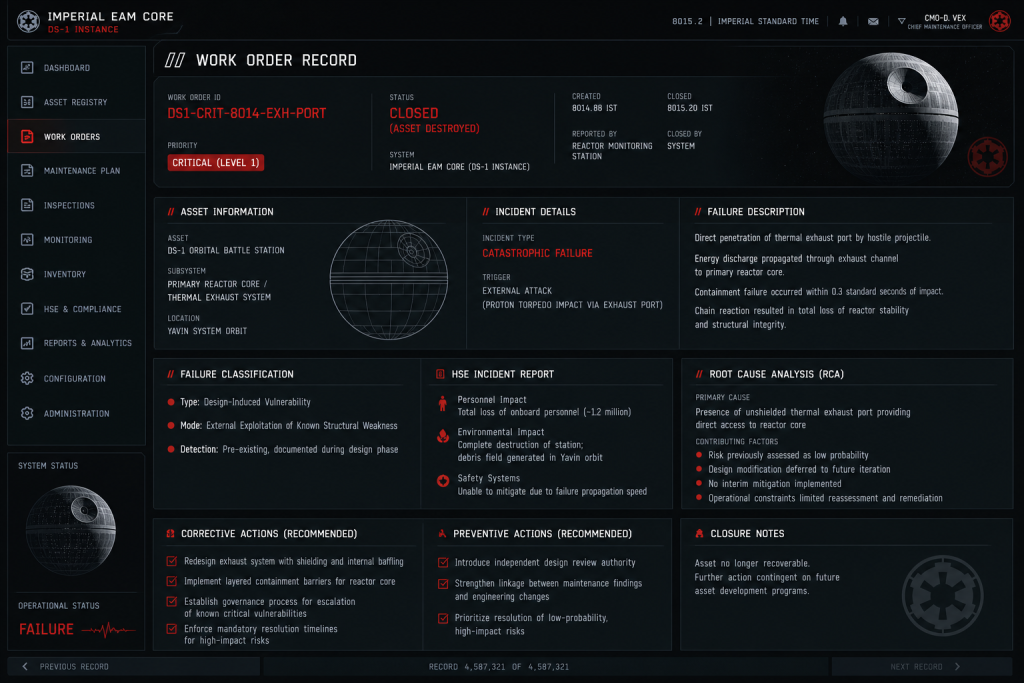
EAM WORK ORDER RECORD
System: Imperial EAM Core (DS-1 Instance)
Work Order ID: DS1-CRIT-8014-EXH-PORT
Priority: Critical (Level 1)
Status: Closed (Asset Destroyed)
Asset: DS-1 Orbital Battle Station
Subsystem: Primary Reactor Core / Thermal Exhaust System
Location: Yavin System Orbit
Incident Type: Catastrophic Failure
Trigger: External Attack (Proton Torpedo Impact via Exhaust Port)
Failure Description:
Direct penetration of thermal exhaust port by hostile projectile.
Energy discharge propagated through exhaust channel to primary reactor core.
Containment failure occurred within 0.3 standard seconds of impact.
Chain reaction resulted in total loss of reactor stability and structural integrity.
Failure Classification:
Type: Design-Induced Vulnerability
Mode: External Exploitation of Known Structural Weakness
Detection: Pre-existing, documented during design phase
HSE Incident Report:
Personnel Impact: Total loss of onboard personnel (~1.2 million)
Environmental Impact: Complete destruction of station; debris field generated in Yavin orbit
Safety Systems: Unable to mitigate due to failure propagation speed
Root Cause Analysis (RCA):
Primary Cause: Presence of unshielded thermal exhaust port providing direct access to reactor core
Contributing Factors:
- Risk previously assessed as low probability
- Design modification deferred to future iteration
- No interim mitigation implemented
- Operational constraints limited reassessment and remediation
Corrective Actions (Recommended):
- Redesign exhaust system with shielding and internal baffling
- Implement layered containment barriers for reactor core
- Establish governance process for escalation of known critical vulnerabilities
- Enforce mandatory resolution timelines for high-impact risks
Preventive Actions (Recommended):
- Introduce independent design review authority
- Strengthen linkage between maintenance findings and engineering changes
- Prioritize resolution of low-probability, high-impact risks
Closure Notes:
Asset no longer recoverable. Further action contingent on future asset development programs.
Captain’s Log: 8020.0 | Personal Log, Secure Channel
In a miraculous convergence of luck and fate, I was on an external audit hearing when the Rebels descended on us. I have made it out in one piece; the same cannot be said for the DS-1. In the absence of the station itself, what remains are the records, and within them a reality that is difficult to ignore. Its destruction did not originate in the final moments of engagement, but much earlier, in the quiet decisions that shaped how we understood, documented, and ultimately accepted risk as being part of our status quo.
The Death Star was, by every measurable standard, an extraordinary achievement. It is the biggest project I have ever been a part of, a rare combination of engineering, strategy, and ambition on a scale we are unlikely ever to see again. For all of its greatness, it was still subject to the same fundamental principles that govern all assets, regardless of size or complexity.
We identified the vulnerability. We recorded it within the system. We assessed it against probability and chose not to act, despite my best efforts. Action was deemed inconvenient within the context of competing priorities; the result is a consequence I will have to learn to live with for the rest of my life.
I have a meeting scheduled with Lord Vader tomorrow to discuss next steps.