by Berend Booms, Associate Editor, Future of Assets
From a very young age, video games have been a way for me to expand my horizon, have fun, and lose myself in something that felt both challenging and rewarding. Like many people who grew up gaming, there have definitely been moments where I went overboard. In high school and college, I had many late evenings chasing progress, optimizing characters, and always opting to go for one more game, to get just a little more value out of the ample amount of time I invested.
At the time, my gaming habits were mostly a hobby. Looking back now, with years of experience in asset management behind me, I can appreciate that those late-night hours brought me some valuable lessons. They helped me begin to understand how complex systems behave. At the time, I just didn’t have the language or contextual awareness to put things into perspective.
One game in particular stands out when I reflect on this today: World of Warcraft.
World of Warcraft is a long-running online role-playing game in which millions of players inhabit a persistent virtual fantasy world, developing characters over time through exploration, collaboration, and continuous investment in skills, equipment, and resources. What makes the game so compelling is that it is not a game you “finish;” it is a living system.
Because your character persists over time, the decisions you make and how you choose to spend your time matter a great deal. This starts the moment you enter the game, when you are asked to align yourself with either the honor-bound Alliance or the fiercely resilient Horde. You then choose one of many distinct fantasy races, each with subtle strengths and limitations, and you commit to a class that ultimately defines not only your own experience of the game, but also how you interact with others. Throughout all of this, your choice of gear to equip matters, and your skills and spells compound to add to the complexity. Those early decisions quietly shape what becomes possible later; while neglect has consequences, so does blind investment. There is always another piece of gear that is better, another adventure to embark on, and another optimization path promising marginal gains.
I find this is very similar to how assets behave in our physical world. They live within ecosystems of people, processes, environments, and expectations. As they age, they evolve and so do their requirements. They respond to how they are maintained and operated. And, just like in World of Warcraft, not every investment delivers the value you expect.
Grinding vs. Value Creation
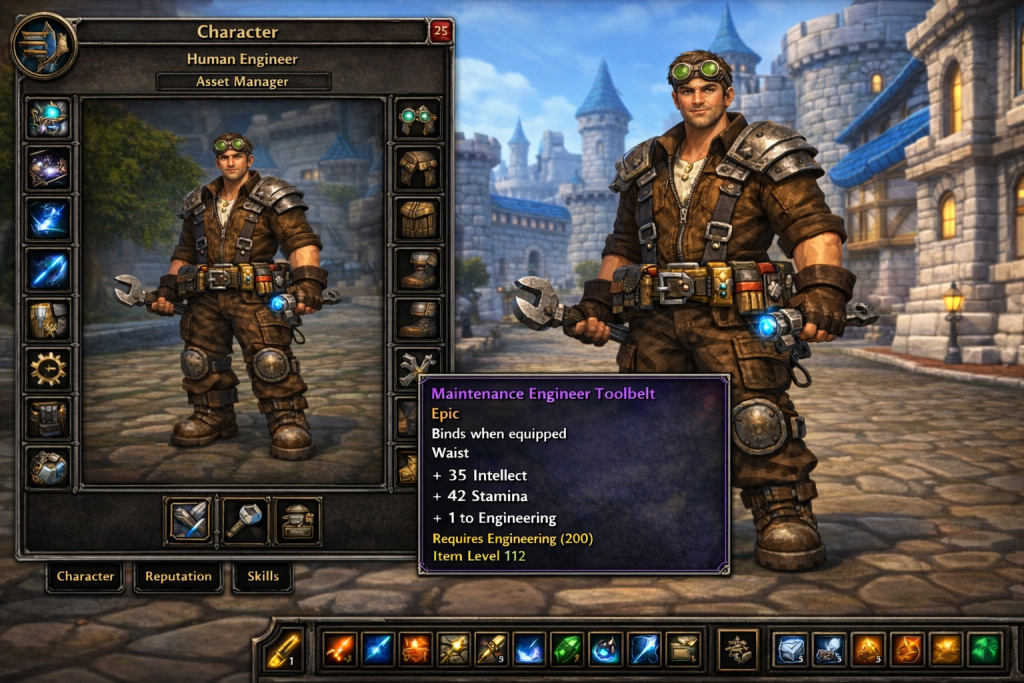
If you have ever played World of Warcraft or any game similar to it, you will know the concept of grinding: repeating the same activity over and over to slowly improve your character. It feels productive, because you are constantly busy. You see the numbers go up, and as such, progress appears measurable. But at some point, you have to ask yourself whether the effort still makes sense.
In asset management, I can sometimes see the same pattern. Maintenance plans become overloaded and activities start to accumulate because “that’s how it’s always done.” While teams seemingly are very busy, the link between effort and outcomes becomes harder to trace. At the end of the day, your uptime doesn’t improve, your risk doesn’t go down, and all the while, costs quietly rise.
Slaying boars in the online world for hours on end has taught me that grinding creates motion, but this is not the same as creating value. My takeaway from this is simple: activity is not the same as impact; progress requires intentionality, not just repetition. The relentless focus on activity not only distorts how value is measured, it changes people’s experience and appreciation for the thing they once enjoyed doing.
Overoptimization and Burnout
World of Warcraft also taught me something more personal. There was a time when I was living more in the digital World than our physical world. I tried to be as good at the game as possible. I researched optimal builds for my main characters, I charted a path to the best gear I could attain and was obsessed with add-ons that would show me how good my healing or damage per second was compared to other players. Slowly, over time, the fun disappeared. I was still logging in to the game, still grinding, but not doing anything of substance per se. I remember being logged in to the game for four hours one night during finals week just to try and increase my reputation with this faction, and it suddenly all felt meaningless. I had pushed myself too hard and overstayed my welcome in Azeroth.
Something similar happens in asset management when organizations over-optimize without perspective. Assets are run closer to or beyond their limits, and as maintenance windows shrink, operations become fragile. When teams are showing up but constantly operating under pressure, failures become more disruptive. People start disengaging and before you know it, they are ready to “log out.” Just like in gaming, optimization without balance leads to burnout. This affects your assets, but most importantly, it blows the people that care for them out of the water.
Progress at Scale is Never a Solo Effort
One of the clearest lessons World of Warcraft taught me is that progress at scale is never a solo effort. While individual play certainly has its appeal and place, the most meaningful challenges in the game are designed for guilds: coordinated groups of players, sometimes up to forty people, each bringing a specific role to the table. Tanks absorb damage and create stability, healers sustain the group and offer resilience, and damage dealers focus on execution and throughput. None of these roles succeeds in isolation, and overemphasizing one at the expense of the others quickly leads to failure.
Asset management works in much the same way. Maintenance, operations, and safety teams each view the asset from a different angle, with distinct responsibilities and priorities. Real efficiency is not when one function dominates, but when these disciplines work together toward shared objectives. Just as a well-functioning guild achieves far more than any individual player ever could, cross-departmental collaboration is what allows asset-intensive organizations to move beyond local optimization and deliver outcomes that matter at system level.
Knowledge Management: Where the World of Warcraft and the World of Assets are Worlds Apart
It is very tempting for me to draw clean parallels between World of Warcraft and asset management, but there are some important differences. One of the most striking ones is how successfully World of Warcraft has captured, structured, and democratized tribal knowledge.
Over the years, an enormous ecosystem of fan-made add-ons has emerged to guide players through the game. Tools like Questie, Details! and WeakAuras overlay real-time insights directly onto the player’s screen, warning them of emerging risks, highlighting priorities, and translating complex mechanics and performance data into actionable guidance. On top of that, community-driven websites such as Wowhead and Icy Veins have become living knowledge bases. These platforms do more than inform; they connect players, create shared language, and foster a sense of collective learning.
Asset management can take an important lesson from this. Unlike in World of Warcraft, the challenge our industry faces is not just complexity, but time. Most of the institutional, tribal knowledge about assets lives in the heads of a select few highly experienced technicians and engineers. They have spent decades learning how systems behave in the real world, and many of them are now approaching retirement. Their expertise is rarely written down; it is contextual, situational, and often only visible in the moment of work.
As this generation begins to step away, the question becomes how to capture and transfer that insight before it is lost. Technologies such as wearables, augmented and virtual reality, and mobile decision support are beginning to close that gap. When used well, they can surface the right information at the right moment, guide less experienced workers through complex tasks, and gradually externalize expertise and democratize knowledge that was once purely tribal. While we may never have a single “add-on” that solves everything, the direction of travel is clear: bringing insight closer to the point of work, much like those World of Warcraft overlays do for players in the heat of a raid.
Why These Lessons in Asset Management Matter Now
It has been close to a decade since I last played World of Warcraft, yet I still think about the game a lot. It gave me my first taste of system thinking, of considering trade-offs for investments. It taught me about the cost of over-investing, and the pitfall of mistaking effort for progress. The parallels with the world of asset management are not perfect, but for me they are powerful.
Both worlds reward those who step back, understand the system, and make deliberate choices over time. And both quietly punish those who assume that doing more, faster, and harder is always the right answer.
Asset management is becoming more complex, not less. Tools are more advanced, data is more abundant, and therefore the temptation to optimize everything is stronger than ever. But the future of assets will not be defined solely by how efficiently we can push systems. It will be shaped by how thoughtfully we manage trade-offs over time, and how we make the right choice between performance and resilience, cost and risk, and activity and value.
Sometimes, the most future-ready decision is not to grind harder, but to pause, reflect, and choose differently.