By Berend Booms, Associate Editor | Future of Assets
Last week, on the 8th floor of the Orchard in Central London, I sat with my eyes closed while calming music played, surrounded by a room full of field service leaders doing the same. I was at Future of Field Service Live, and I had come mainly to spend time with the team behind Future of Assets: Sarah Nicastro, who is the Managing Director and also my mentor, and Charlotte Wylde, our Digital Experience & Social Media Manager. There is nothing quite like getting face-to-face time, especially now that so much of our work happens through a screen. Being in a room together gives you something no prompt can create.
Sarah made sure that the event got off to a good start by talking about how we all have priorities in life. Hers are being a mom first and a leader second. It’s a really important point that is worth repeating: all of us have these multiple roles that we are juggling, and with many of these roles vying for our attention and begging for our energy, maintaining a healthy work-life balance can be very challenging. I have been trying to be the best father, the best partner, the best brother, the best colleague, the best friend, the best everything, and as a result I sometimes feel like I’m not the best at anything. Hearing Sarah voice this struggle out loud was reassuring to me, and it set the right tone for the rest of the event.
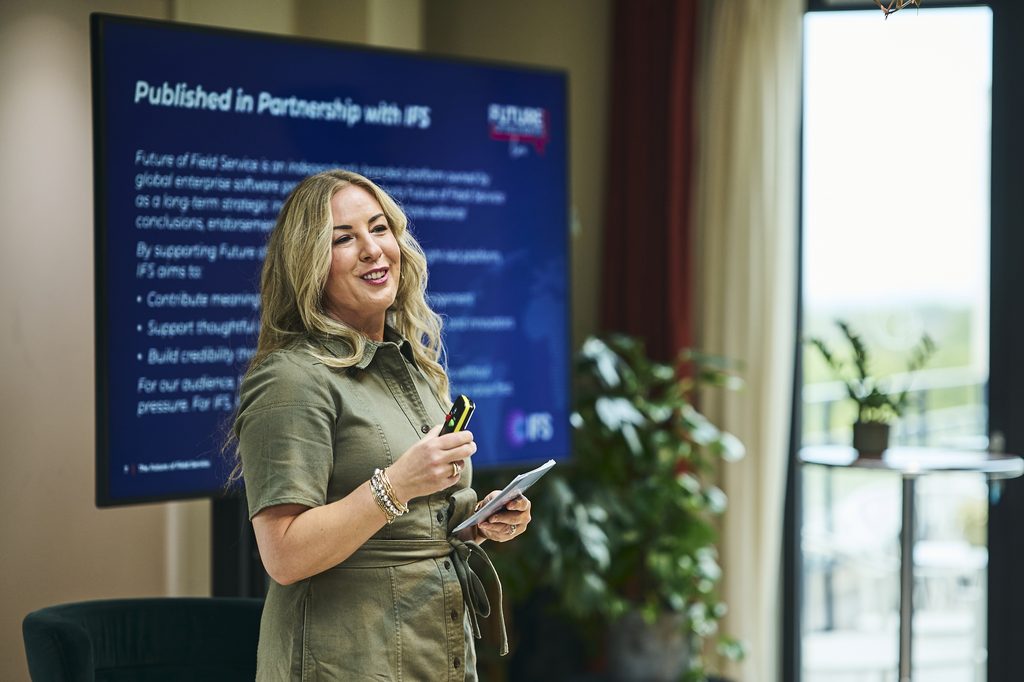
I’ve been to enough events to know that most dive straight into technology. Future of Field Service Live was the exception to this rule: what followed the welcome keynote was an oasis of calm.
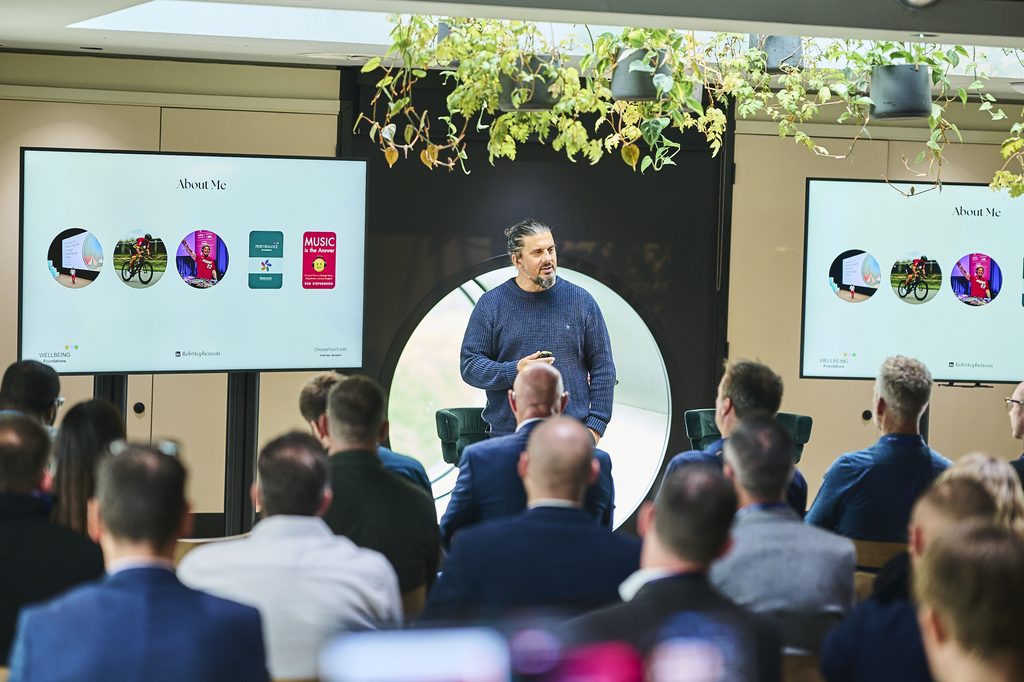
That moment of calm I got to experience was Rob Stephenson’s doing. He asked us to close our eyes and let go of whatever we had carried into the room, and for a moment we could just be. His keynote focused on us: our wellbeing and our energy. Rob is the author of ‘Music Is the Answer’', published by Wiley this August. Through his own experience and challenges, Rob explained how music is exceptionally good for our mood, helps our sleep, and boosts motivation.
Rob then asked everyone in the room to think about the one song that always gives them an energy boost. After roughly 30 seconds of explanation, he got a room full of service leaders to think about music. I love how he turned the title of his book into something you do. His talk and the ideas he presented around energy and wellbeing landed really well with me, so in this piece I want to explore them more deeply, and share some songs for each of the ideas explored.
The Question in the Room
Back to Rob’s question: what is the one song that never fails to put you in a good mood? I was quick to submit my answer: “Lovely Day” by Bill Withers. It’s my go-to when I need a good start to my day.
When I took some time to think about why that is, most of my appreciation for the song is based on feelings. I feel better after hearing the song, it lifts my spirits, it makes me feel happier and the joy in the song is infectious. Rob’s point is that this ‘feeling’ has science behind it. Research on music is at its strongest here, in mood and motivation. A 2020 review of 139 studies on music and exercise found that music lifts how people feel while they move, and even how well they perform. My conclusion is that music is one of the cheapest and fastest ways we have to positively shape our energy. I have since introduced this song and a few others to my morning routine, and I like what it’s doing for me.
When the Thing That Keeps You Well Is Gone
A big part of Rob’s presentation is based around his own story. He has lived with bipolar disorder for more than three decades. In 2017 he decided to share his story more widely, and since then he has built a career around helping leaders talk openly about mental health.
Rob explained that we all find ways of staying well outside of work: for Rob, this was cycling. Then, the Covid pandemic happened, and Rob came out the other end with Long Covid, which meant that exercise started triggering chronic fatigue. With the thing that kept him level gone, Rob turned to music to fill the void. He had been DJing for more than 20 years, started picking up recording mixes during lockdown, and found it kept him feeling well. It’s the start of the discovery that culminated in his book.
It made me think about how I keep myself level and feeling well. One of the main ways I like to do this is by being in nature. I get my daily ‘fix’ by going for short walks in the forest near my son’s school: I’ll go in around 30 minutes early, do my usual lap, and feel ready and refreshed whenever the school bell signals the end of his day. The catch is that the walks are tied to the school run. When school is out for the holidays, my walks disappear with it. I notice that this gives way to a sort of restlessness that is beautifully captured by the song “Arriving Somewhere But Not Here” by Porcupine Tree. Without my daily walks to keep me grounded, I am always moving but never quite getting anywhere; this song gives me twelve minutes of being somewhere else when I cannot get there on foot.
The Song That Makes You Stop
The core idea of Rob’s book is intentional listening. Most of us listen to music but do so on autopilot, with an algorithm often choosing what we listen to next. I’m definitely guilty of this, because while I will often listen to music, I mostly put it on as background noise to whatever other activity I’m doing. Rob suggests that we change this, by choosing music on purpose and paying attention to what it does to us. You don’t need to be a musician or have perfect taste; you just need to listen with purpose.
There’s fascinating science behind why certain songs just seem to grab us. In 2011, a team led by Valorie Salimpoor used brain scans to show that listening to the music you love releases dopamine. Some of that release happens at the emotional peak of the song, and some of it happens beforehand, in the anticipation, while you wait for the moment you know is coming.
In thinking about intentional listening, there is one song that I cannot and will not hear as background music. It’s one of my all-time favorite songs, “Time in a Bottle” by Jim Croce. He wrote the song after he found out his wife was pregnant with their son, and as a father to two boys, the lyrics just cut straight through me, hitting me right in that part of the body that I can only describe as “the feels.”
Energy Is the Currency
My key takeaway from Rob’s keynote was his line that energy is the true currency of sustainable performance. As he put it, we can always find more time, but we can’t manufacture more energy.
This idea has a history, as Jim Loehr and Tony Schwartz made a very similar argument in ‘The Power of Full Engagement’ back in 2003. What Rob adds is timing, and he added it in a casual yet masterful way by asking a simple question: if AI lets us do in one hour a task that used to take a full day, what are we going to do with the rest of that day?
I fell right into the trap. More time in my day sounds amazing, because I can get more work done and clear more of my to-do list. Rob has helped me realize that while this is not an incorrect answer necessarily, it is definitely incomplete. He suggests that we fill some of that surplus time with what nourishes us, taking care of our physical, mental, and emotional wellbeing. He argued that wellbeing should be baked into the way a business is run, rather than showing up as a perk.
The song I would pick for this is Pink Floyd’s “Time.” Besides being hauntingly beautiful, the song tells the story of someone who looks up one day to find that years have gone by while he waited for his life to begin. That warning gets louder the older I get, and louder still now that the time AI gives back is usually spent on being productive, rather than being mindful about my wellbeing.
Rest Is Part of the Work
I was reminded by a splitting headache on the flight back home that energy you expend has to be replenished. Sleep is where that replenishing starts, and the science on music and sleep is encouraging. A 2022 Cochrane review of 13 trials, covering just over 1,000 adults with insomnia, found that listening to music for 25 to 50 minutes a day improved how well people felt they slept.
Think of it this way: in our industry, nobody would run a critical asset at full load forever and skip the maintenance window. So why is it that we seem far more willing to do that to ourselves? Rob made the point that many organizations say they want sustained high performance, then design for permanent peak performance instead. “Sleep” by The Dandy Warhols is a dreamy, hazy song that I really enjoy listening to and that came to mind. It’s one that I’ll put on after a long day, or in this case after I come home from an event, to unwind and relax, and perhaps to put myself in the right headspace for a good night’s sleep.
Your Song
Rob’s keynote left me feeling inspired and motivated to change up my routine. He made me realize that small wellbeing steps, taken regularly, add up to big gains over time. Listening to music is already part of my day-to-day, so this is about as small as a step can get.
I’ll end on the question Rob asked us: What is the one song that never fails to set you right? Tomorrow morning, before you open your laptop or check your email, listen to that song, and see what happens to the rest of your day.