By Kevin Price | Global Head of Enterprise Asset Management
Do any of these statements sound familiar to you...
“The project was planned to perfection…. but it became so bumpy after it was handed for execution”.
“We had the best intentions, but lost control of where the actual risks were that we planned for”.
“We planned for what we thought…and we executed on what we expected. But pivoting quickly from key collaborative decision-points was not our strength. We forgot to “look at the forest, instead of just the trees””.
If these, and even more similar quotes come to mind, then please know that what you are experiencing is not unusual, but common in your industry.
In asset-intensive and risk-critical industries, project failure is rarely caused by a single catastrophic event. More often, it is the result of a gradual breakdown between what was planned and what is ultimately executed. An engineering project may begin with a compelling business case, approved funding, and a technically sound design. Yet once execution starts, small gaps in governance, risk visibility, decision-making, and information quality compound into delays, cost overruns, rework, and underperformance – and these are just a few of the more common reasons for project failures.
The reality is that the execution phase is where optimism meets operating reality. Drawings become work packages, procurement promises become delivery constraints, assumptions become field decisions, and every unresolved risk starts to consume schedule, contingency, and stakeholder confidence. This is why disciplined risk management is not simply an assurance function. It is the connective tissue that keeps planning, execution, commissioning, and long-term asset performance aligned – and without modern solutioning that is ready-and-able to meet the vast collaborative needs of real organizations, yours will more than likely become the next story or statistic.
Across industrial capital projects, the same five failure patterns consistently appear: poor governance and delayed decisions, weak scope and change control, productivity underperformance, inadequate risk escalation, and poor information quality that drives rework. These are not isolated project management issues. They are lifecycle value issues because execution decisions directly influence safety, reliability, maintainability, regulatory compliance, and return on invested capital for decades.
The Big Idea: Industrial projects do not usually fail because teams lack effort. They fail because risk signals are fragmented, handoffs are informal, decisions are delayed, and project assumptions are not continuously tested against execution reality.
1. Governance and decision latency
Projects move at the speed of decisions and should always meet the need for a larger solution, not address symptoms. When engineering teams, contractors, procurement groups, operations, and owners cannot resolve issues quickly, crews begin working around problems rather than solving them. Field teams wait for approvals, contractors submit claims, and schedule contingency is consumed. A small design question can become weeks of delay when decision rights, escalation paths, and accountability are unclear.
How risk management reduces the failure of decision-making speed: Risk management reduces this failure by making decision exposure visible. A well-maintained risk register links each high-impact uncertainty to a named owner, impact window, mitigation strategy, and escalation threshold. Governance forums then shift from status reporting to risk-based decision-making, forcing early intervention before unresolved issues become critical path delays.
2. Scope, change, and interface breakdowns
Every project change has a ripple effect, in every direction. A revised design package may alter procurement requirements, equipment lead times, construction sequencing, commissioning activities, and operational readiness. In complex industrial projects, the greatest risk often sits at the interfaces between engineering, procurement, construction, digital systems, maintenance, and operations.
How risk management reduces the failure of collaboration change breakdown: Risk management reduces this failure by connecting scope control, Management of Change, and interface management. Changes should be assessed not only for cost and schedule but also for safety, reliability, maintainability, regulatory exposure, and lifecycle cost. This ensures that scope changes are conscious business decisions rather than uncontrolled project drift.
3. Resource and productivity underperformance
Many execution schedules assume productivity levels that never materialize. Labor shortages, contractor capability gaps, material constraints, inefficient work packaging, limited supervision, and site access issues reduce field productivity. As productivity falls, overtime increases, quality declines, and safety exposure grows.
How risk management reduces the failure of underperformances: Risk management reduces this failure by treating productivity as a measurable risk rather than a lagging performance issue. Forecasting tools, earned value analysis, constraint logs, and short-interval planning expose productivity deterioration early. Mitigation can include resequencing work, improving material availability, adding supervision, revising crew composition, or renegotiating contractor performance expectations.
4. Poor risk escalation and the illusion of control
One of the most dangerous conditions in project delivery is the appearance of control. Dashboards stay green, risk registers become static, and teams normalize emerging problems as temporary. By the time leadership recognizes the severity of the issue, recovery costs have multiplied and available options have narrowed. The more common challenge, again, is solutioning for the symptoms versus the larger problem.
How risk management reduces “control” point of failure: Risk management reduces this failure by establishing leading indicators and escalation triggers. A risk should not remain on a register without a mitigation owner, target date, residual risk rating, and defined trigger for executive intervention. This converts risk management from documentation into a management operating system.
5. Poor information quality and rework
Industrial engineering projects execute information that affects everything. If drawings are inaccurate, asset data is incomplete, vendor documentation is late, tag structures are inconsistent, or field changes are poorly controlled, crews spend time correcting errors rather than creating value. Rework is one of the largest hidden destroyers of cost, schedule, quality, and commissioning performance.
How risk management reduces the failure of quality and rework: Risk management reduces this failure by making information readiness a formal execution risk. Engineering data, document control, asset hierarchy, spare parts strategy, maintenance plans, and commissioning requirements should be validated before field execution accelerates. This is where Asset Lifecycle Management adds value by preserving continuity between project data and operational asset records.
Common Tools for Tracking the Planning-to-Execution Handoff
The handoff from planning into execution is one of the most important control points in the project lifecycle. It is the moment when strategic intent, engineering assumptions, commercial commitments, asset data, workforce plans, and operational readiness must become a single executable baseline. Leading organizations formalize this transition using a set of practical tools that are operational and technical.
| Tool | Primary Purpose in the Handoff |
| Stage-Gate Reviews | Validate phase readiness before moving from concept to FEED, FID, construction, commissioning, and operations handover. |
| Risk Register | Tracks threats, opportunities, owners, mitigation actions, residual exposure, review dates, and escalation thresholds. |
| RAID Log | Maintains continuity of risks, assumptions, issues, and dependencies across planning and execution teams. |
| Integrated Master Schedule | Connects engineering, procurement, construction, commissioning, and operational readiness into one controlled schedule baseline. |
| Management of Change | Ensures changes are evaluated for cost, schedule, safety, reliability, compliance, and lifecycle performance. |
| Interface Register | Tracks dependencies between contractors, disciplines, packages, systems, vendors, and operational stakeholders. |
| Decision Log | Documents key decisions, decision owners, due dates, rationale, and implementation status. |
| Commissioning and Handover Checklists | Verify that assets, documents, spares, procedures, training, and maintenance strategies are ready for operations. |
| Digital Asset Information Hub | Maintains continuity of asset hierarchy, tags, drawings, vendor data, maintenance plans, inspection records, and risk history. |
Relevant Standards in Asset-Intensive and Risk-Critical Industries
Risk-critical industries also benefit from established standards that define expectations for risk governance, project control, asset management, safety, reliability, and operational readiness. These standards do not guarantee project success, but they create a common language for managing uncertainty across owners, contractors, regulators, and operators.
| Industry / Domain | Relevant Standards | Risk-Control Contribution |
| Cross-industry asset management | ISO 55000 / ISO 55001 | Asset management system requirements, lifecycle value, risk-based asset decisions, and governance. |
| Enterprise and project risk | ISO 31000 | Risk management principles and framework applicable across capital projects and operations. |
| Project and program management | PMI PMBOK Guide; ISO 21502 | Project governance, scope, schedule, cost, risk, resource, stakeholder, and quality management. |
| Cost engineering and project controls | AACE International Recommended Practices; EIA-748 | Cost estimating, schedule analysis, earned value management, risk analysis, and performance control. |
| Oil, gas, chemicals, and process industries | API RP 580 / 581; IEC 61511; CCPS guidance | Risk-based inspection, process safety, functional safety, hazard analysis, LOPA, and operational risk management. |
| Electric utilities and power | NERC reliability standards; ISO 55001, EPA Guidelines | Grid reliability, cyber and operational controls, lifecycle asset management, and critical infrastructure risk governance. |
| Rail and transportation systems | EN 50126 / 50128 / 50129; ISO 55001, FRA | RAMS: reliability, availability, maintainability, and safety across system lifecycle. |
| Aerospace and defence | MIL-STD-882; AS9100; EIA-748 | System safety, quality management, earned value, hazard tracking, and mission assurance. |
| Construction and infrastructure | ISO 19650; Various NEC / FIDIC contract frameworks | Information management using BIM, contract governance, change control, and collaborative project delivery. |
| Manufacturing | ISO 55000 / ISO 55001, FDA | Asset management system requirements, process linearity and resiliency, regulation compliance. |
The Asset Lifecycle Management Perspective
The highest-performing organizations view project execution not as a standalone construction activity but as a critical stage in their Asset Lifecycle Management (ALM) journey. The objective is not simply to deliver a project on time and on budget. The objective is to deliver an asset that performs safely, reliably, and profitably for decades to come – after all, we build everything to last, right?
Under an ALM approach, every project decision is evaluated against long-term operational impact. Risk management becomes the mechanism that connects strategy, engineering, project execution, operations, maintenance, and eventual renewal. The planning-to-execution handoff becomes more than a project milestone. It becomes the point where business intent is translated into an executable, governable, and maintainable asset strategy using key data “ingredients” from the most used enterprise solutions such as Enterprise Resource Planning (ERP), Enterprise Asset Management (EAM), Field Service Management (FSM), Asset Performance Management (APM), and more. Well-oiled and seamlessly integrated, these solutions will unveil unyielding potential of enormous value – and with the advent of possibility through Artificial Intelligence (AI) tooling, there is even value to consider and insights to discover.
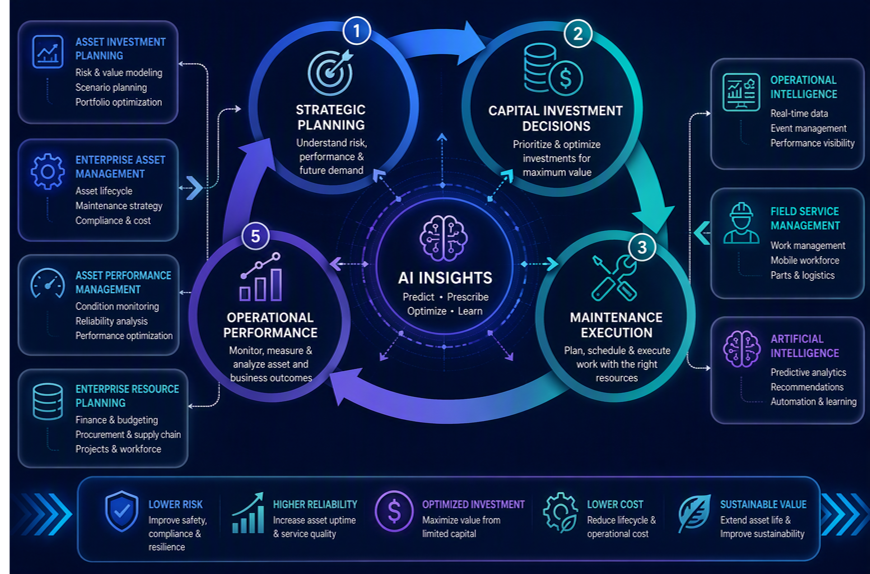
Simply put…Organizations that master this discipline reduce their risk of execution failure by creating a closed-loop system: risks identified during planning are actively controlled during execution, lessons learned during construction inform future investment decisions, and operational performance validates whether the asset delivered the value originally promised.
That is the real difference between managing projects and managing the larger lifecycle value – and the ultimate reason why these “most common” failures from the Strategic Planning phase to the Execution phase can be routinely avoided.
Selected References
McKinsey & Company. Seize the decade: Maximizing value through preconstruction excellence. https://www.mckinsey.com/capabilities/operations/our-insights/seize-the-decade-maximizing-value-through-pre-construction-excellence
McKinsey & Company. An executive's survival guide to capital projects. https://www.mckinsey.com/capabilities/operations/our-insights/an-executives-survival-guide-to-capital-projects
McKinsey & Company. Don't cancel or coddle at-risk capital projects. Challenge them. https://www.mckinsey.com/capabilities/operations/our-insights/dont-cancel-or-coddle-at-risk-capital-projects-challenge-them
Project Management Institute. Why do projects really fail?. https://www.pmi.org/learning/library/identify-factors-cause-project-failure-2442
Project Management Institute. Why do projects really fail? Avoiding failure. https://www.pmi.org/learning/library/why-projects-really-fail-avoid-4138
ISO. ISO 55000 Asset management and ISO 31000 Risk management standards. https://www.iso.org
API. API Recommended Practice 580 and 581. https://www.api.org
AACE International. Recommended Practices for cost engineering and project controls. https://web.aacei.org/resources/publications/recommended-practices